Amazon Fresh · 2026 · Climate Impact Design Challenge
Smart Bundles: a predictive cart layer that reduces household food waste before checkout
A concept for Amazon Fresh that turns the cart from a passive checkout surface into a decision-support layer: right-sizing perishables, grouping ingredients into complete-use bundles, and learning from lightweight feedback over time.
Overview
The cart is optimized for speed, not purchase quality.
Household food waste is a systems problem hiding inside everyday shopping defaults. Digital grocery makes it easy to over-buy perishables, duplicate ingredients, and leave shoppers with partial-use items they never meant to waste. Smart Bundles reframes Amazon Fresh as a decision-support system: using behavioral signals to right-size quantities, group products into complete-use bundles, and learn from lightweight post-delivery feedback.
The leverage point is not education — it is the cart. Once items enter the home, waste is already likely. The cart is the last moment where the product can improve quantities and ingredient completeness before food is purchased.
Product
A predictive bundling layer inside Amazon Fresh that helps shoppers buy the right amount of food for actual household use.
Problem
The current cart optimizes checkout completion, but not whether purchased food will actually get used.
Core idea
Use historical and contextual signals to suggest right-sized quantities and complete-use bundles before checkout.
System loop
Detect risk → recommend bundle or quantity edit → preserve control → learn from edits and post-delivery feedback.
Design challenge
Design a climate-positive upgrade inside an existing digital grocery ecosystem without asking users to fundamentally change how they shop or cook.
Constraint
10-hour sprint → prototype only what mattered at system scale: the loop from suggestion to purchase to learning.
System bet
Waste decreases when the platform changes defaults at the decision point rather than relying on willpower after delivery.
System at a glance
Inputs
Cart contents, purchase history, household size, perishability windows, ingredient overlap, reorder rhythm
Intelligence
Predicts over-purchase risk and proposes right-sized quantities or complete-use bundles
Outputs
Bundle cards, quantity guidance, waste-avoidance messaging, feedback prompts
Feedback loop
Edits, dismissals, and post-delivery feedback improve later bundle sizing and intervention quality
What I'm optimizing for
Not a meal-kit substitute. Not a guilt-driven sustainability feature. A lightweight decision layer that improves purchase quality while staying compatible with normal grocery behavior.
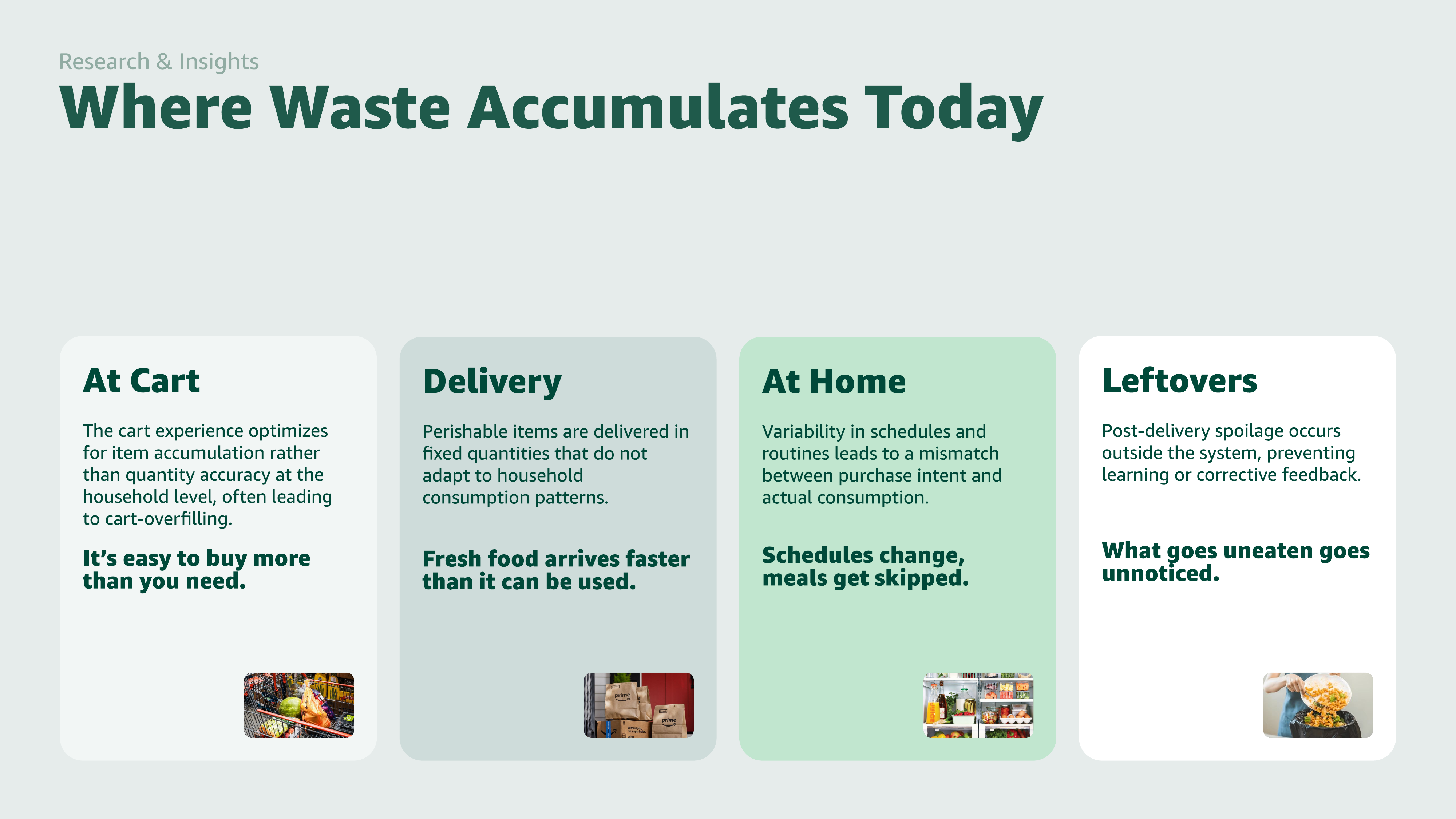
Where food waste emerges in the grocery journey
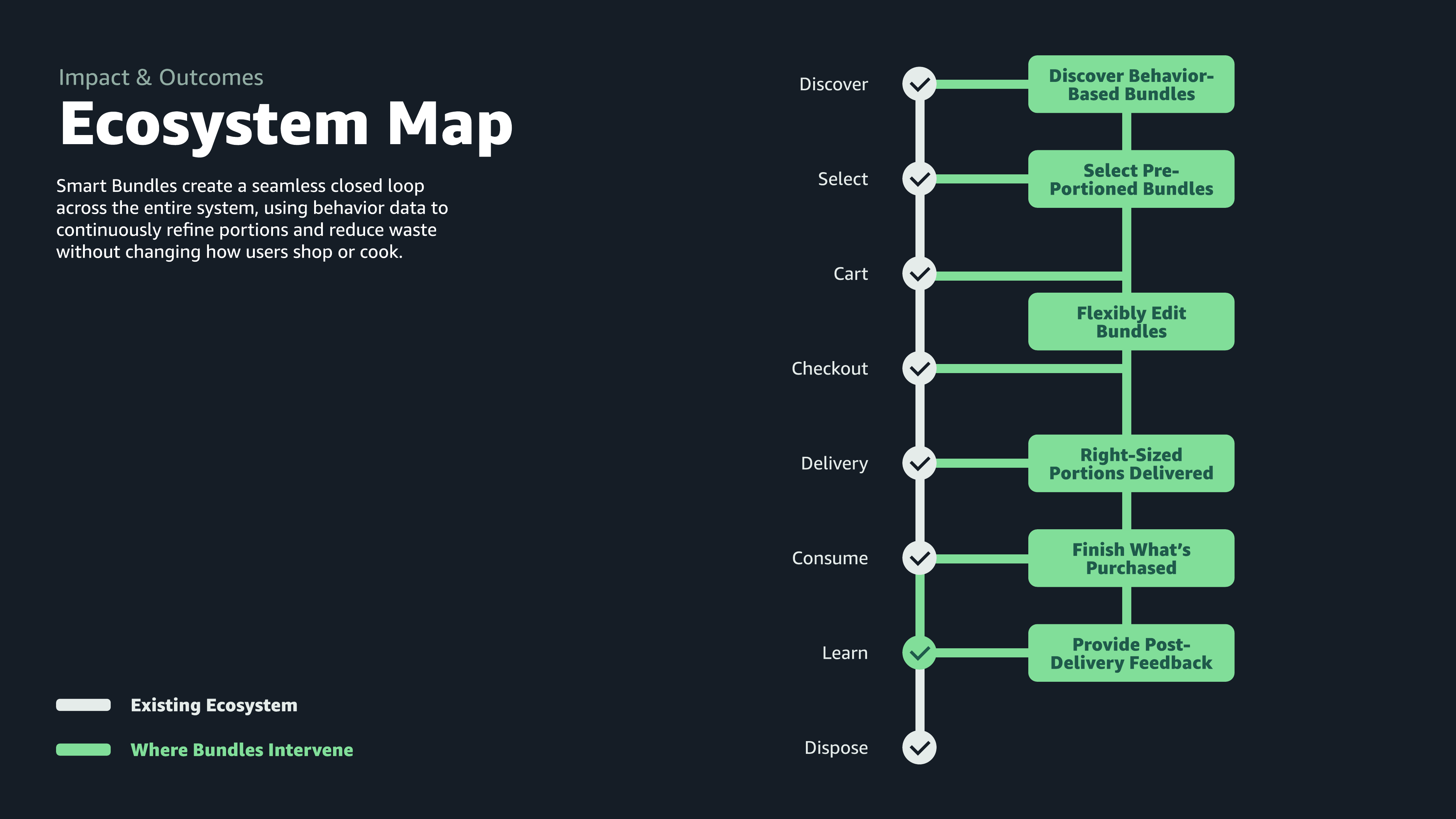
Discover → Select → Cart decisions → Checkout → Delivery → Consume → Waste
Most existing interventions happen after purchase. Smart Bundles moves the intervention earlier — where quantities and ingredient completeness are still adjustable.
Research
Waste is behavioral, and the highest leverage sits inside repeat household patterns.
I anchored the concept in a simple product insight: broad awareness does not help if the system's default behavior still produces over-purchase. The opportunity is not to teach shoppers about waste in the abstract. It is to intercept the small, repeated cart decisions that create spoilage later.
Climate impact
Food loss and waste account for a meaningful share of global emissions, which makes prevention a direct climate lever rather than just an efficiency improvement.
Household contribution
A large portion of waste happens at the household level, where purchase volume and perishability frequently fall out of sync.
Behavior pattern
Waste tends to cluster around the same classes of items: perishables, duplicate ingredients, and products purchased without a clear complete-use plan.
Why Amazon Fresh
Amazon Fresh is a strong surface because it already has the signals this system needs: purchase history, cart behavior, reorder rhythm, and the scale to test whether better defaults can improve both household outcomes and business performance.
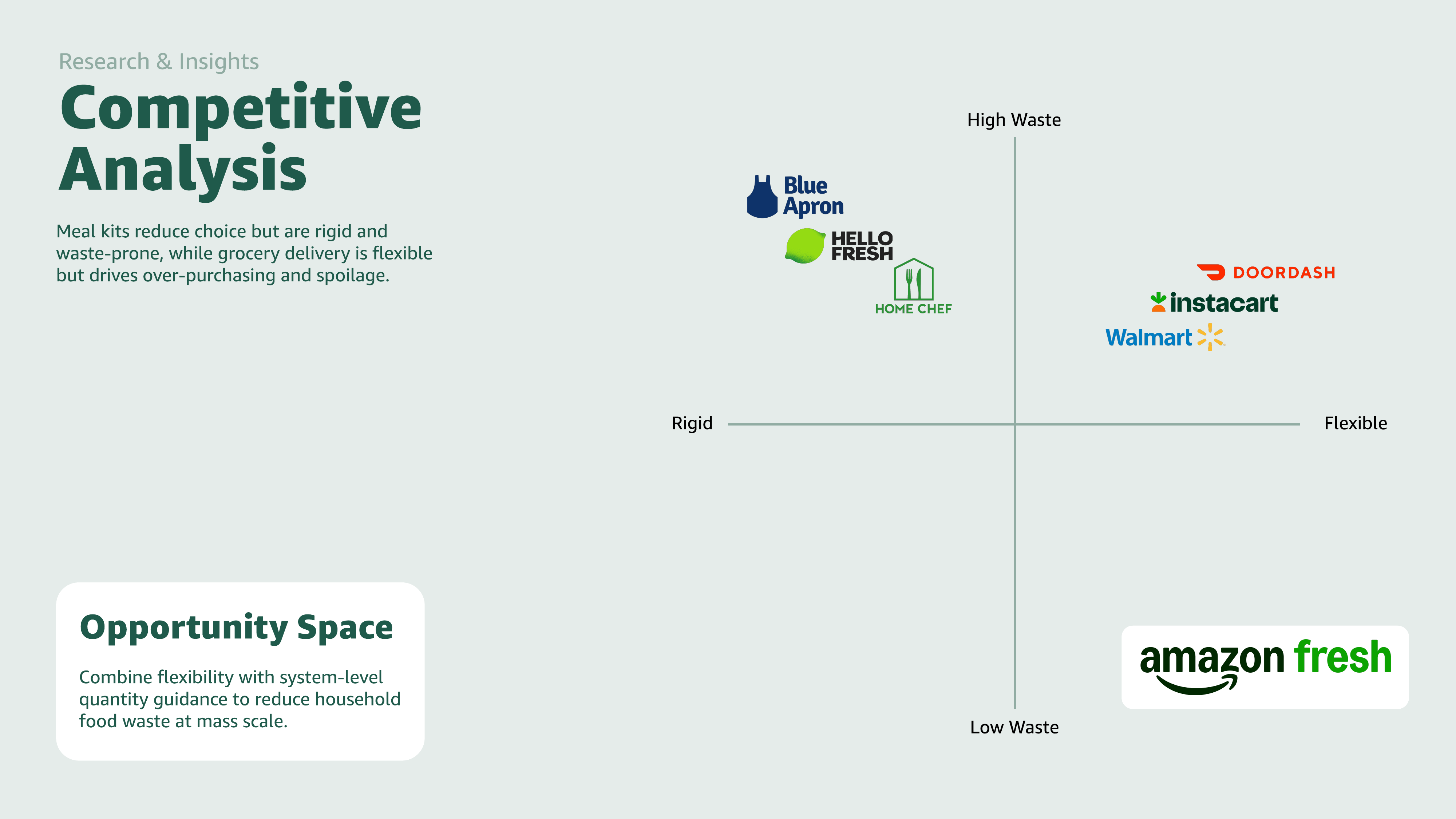
Opportunity space
Meal kits reduce waste but constrain choice. Standard grocery preserves choice but leaves shoppers to solve planning and quantity optimization themselves.
Product gap
Smart Bundles sits between those models: flexible like grocery, but guided enough to reduce orphan ingredients and over-buy risk.
Solution
A flexible bundling layer that right-sizes quantities before waste enters the home.
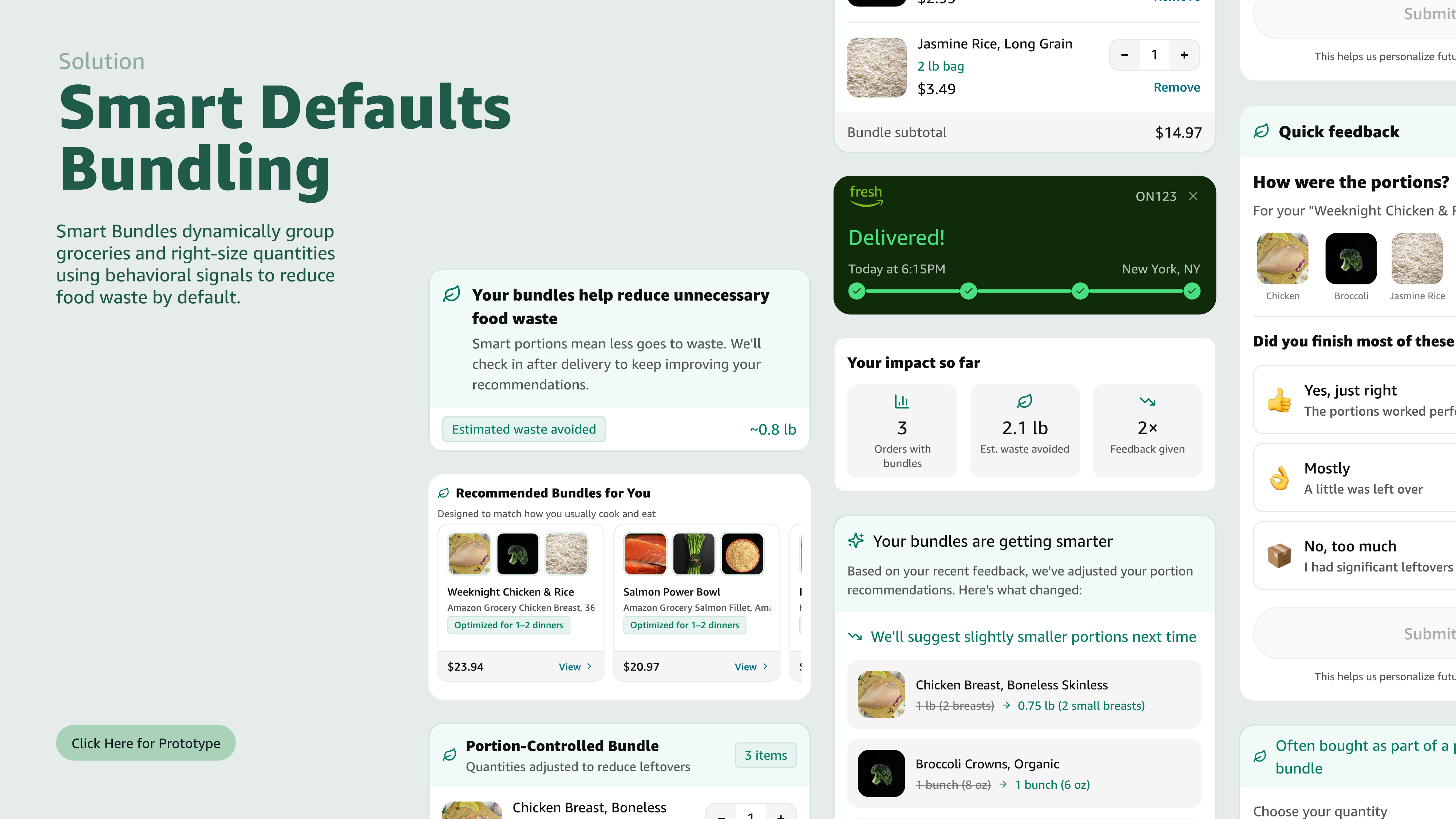
Smart Bundles introduces three linked mechanisms: suggest smaller quantities when over-purchase is likely, group products into complete-use bundles when ingredients naturally fit together, and learn from lightweight post-delivery feedback so recommendations improve across orders.
1 · Right-sized quantities
Suggests smaller portions when past behavior indicates excess volume, with a clear rationale and one-step editing.
2 · Flexible bundles
Groups products into complete-use ingredient sets that preserve grocery flexibility without turning the experience into a rigid meal-kit flow.
3 · Lightweight learning
Uses edits, dismissals, and optional "too much / too little" feedback to refine recommendations over time.
Product positioning
Meal kits simplify cooking by removing decisions. Smart Bundles simplifies grocery shopping by improving only the decisions that most often create waste.
System Logic
Designing the intelligence layer — not just the interface.
The core design problem was not just generating bundle suggestions. It was defining when the system should intervene, how assertive it should be, and how it could improve without disrupting checkout flow.
Smart Bundles is intentionally designed as a lightweight decision-support system embedded inside the cart. Predictions are advisory, never enforced. The product should feel helpful when it is right and ignorable when it is wrong.
How the system decides when and how to intervene
Identify where a cart is likely to produce waste.
- perishable item types
- quantity size vs typical use
- ingredient overlap across items
- purchase history and reorder rhythm
- household size estimates
Select the lightest useful action.
- no intervention
- suggest smaller quantity
- generate complete-use bundle
- flag duplicate or orphan ingredient
- schedule post-delivery feedback
Present help without interrupting checkout.
- advisory rather than blocking
- visible before checkout commitment
- editable in one interaction
- rationale available via "Why this?"
Improve later recommendations with minimal user effort.
- bundle accepted or ignored
- quantity edits in cart
- post-delivery "too much / too little" feedback
- future reorder timing
This makes the product less about "AI recommendations" and more about calibrated decision support: intervening only where the system can improve purchase quality without adding friction. The long-term value is not the first suggestion — it is the system learning across orders and gradually improving portion accuracy for each household.
Key constraint
Recommendations stay non-blocking. The model advises, but the user remains in control.
Cold start
For new users, the system starts with household size and common ingredient pairings, then personalizes as history accumulates.
Failure mode design
When suggestions are wrong, users need fast ways to edit, dismiss, and understand why the recommendation appeared.
Design Decisions
What I chose, and what I intentionally did not build.
1. Target defaults, not education.
Many sustainability concepts rely on messaging after the fact. I focused instead on the upstream moment where the system can still influence what enters the home.
2. Favor flexible bundling over a meal-kit model.
Meal kits reduce waste, but they also narrow choice and increase operational rigidity. Smart Bundles keeps the shopper in a normal grocery flow while still offering structured guidance.
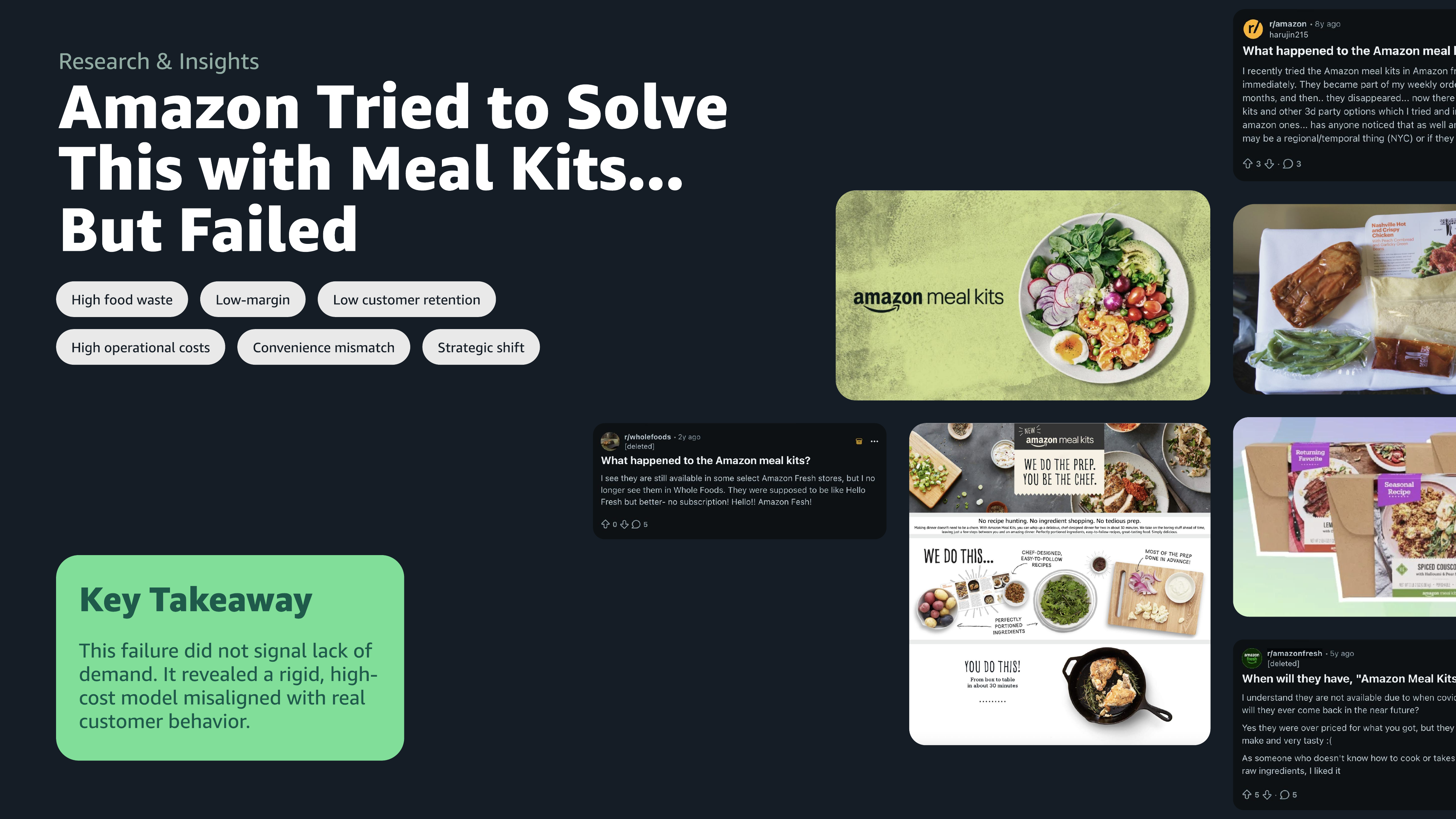
Discarded direction: meal-delivery add-on
Early in the exploration, I prototyped a meal-delivery add-on inside Amazon Fresh that bundled ingredients into structured weekly meal plans. Further research showed Amazon had already launched and discontinued a similar model, suggesting that operational complexity and adoption challenges had already been tested at scale.
That discovery sharpened the concept. Rather than recreate a meal-kit service, I pivoted toward flexible ingredient bundling — preserving user choice while still addressing waste through quantity guidance and complete-use grouping.
3. Make the learning loop the differentiator.
The product is not the first recommendation. The product is the system getting more accurate across orders with near-zero additional effort from the user.
| Option | Upside | Why I didn't choose it |
|---|---|---|
| Meal kits | High structure, lower waste risk | Too rigid for standard grocery behavior and already tested by Amazon. |
| Discount near-expiration items | Moves inventory efficiently | Optimizes warehouse waste more than household purchase quality. |
| Carbon labels only | Low implementation complexity | Informative, but too passive to change quantity decisions. |
| Education tips | Easy to layer in | Low leverage compared with changing defaults in the cart. |
Core Flows
Three touchpoints that prove the system.
Rather than designing a full grocery experience in 10 hours, I prioritized the three moments where the product must be felt: discoverability, checkout continuity, and learning. The flows below are proofs of system behavior, not just UI coverage.
Touchpoint 1: make quantity guidance visible by default
The product earns trust early by surfacing bundles and right-sized quantities before the cart. Sustainable behavior only becomes durable when it also feels convenient and legible.
- Default-first: bundle entry points are treated as primary shopping affordances, not hidden sustainability add-ons.
- Explainability: each recommendation ties to likely use patterns rather than abstract climate messaging.
- Flexible control: users can edit quantities at any point; the system adapts instead of enforcing.
Touchpoint 2: keep bundles intact through checkout
The cart is where waste-risk decisions become real: duplicate perishables, oversized proteins, or missing ingredients that create leftovers without a plan. Bundle continuity helps preserve the complete-use logic while still allowing fast edits.
- Bundle integrity: grouped items stay readable as a unit so the recommendation remains understandable.
- One-tap edits: quantity changes do not break the bundle model.
- Outcome visibility: lightweight "waste avoided" framing reinforces usefulness without moralizing.
Touchpoint 3: learn without asking for effort
Most waste happens outside the app, after delivery. The learning loop closes that gap with a low-friction prompt that captures whether portions were too much or too little and then makes the system's next recommendation better.
- Optional by design: no nagging and no required follow-up.
- Trust reinforcement: the interface explains what changed so users understand the benefit of feedback.
- Behavioral realism: the product helps households improve gradually without requiring strict meal planning.
Recommended 10/10 visual: one clean annotated card or 3-up still frame strip that shows the same recommendation logic across discovery, cart, and learning surfaces.
Impact
A climate-positive concept that also strengthens the business.
Smart Bundles creates an unusually strong alignment: reducing household waste can also improve Amazon Fresh's basket quality, perceived usefulness, and retention. The mechanism is not just "more items" — it is more coherent baskets with fewer regret-driven spoilage moments.
North Star
Estimated food waste avoided per active household per month
This is the clearest product-level outcome because it ties the feature to the user problem, the climate rationale, and the system's long-term learning quality.
User impact
Fewer spoilage moments and less overbuy regret
More coherent carts with complete-use ingredients
A cart experience that feels like planning support, not just checkout
Business impact
Stronger basket quality through bundles that actually get used
Potential retention lift from more helpful defaults
A credible climate story connected to platform behavior, not just messaging
Next Steps
How I'd validate and scale it.
Experiment 1
A/B test: control = standard Amazon Fresh cart, variant = Smart Bundles enabled cart. Measure waste proxies, adoption, edit rate, units per basket, and repeat ordering.
Experiment 2
Inventory-aware bundling: connect bundle generation to near-expiration inventory to reduce waste across both household and fulfillment layers.
Experiment 3
Trust + consent model: validate how much personalization detail should be surfaced and when users should be able to opt out.
Reflection
What this sprint sharpened.
Time pressure forced system-first prioritization.
With only 10 hours, I treated the prototype as proof of a product thesis, not a gallery of screens. I focused on the minimum set of touchpoints needed to demonstrate a closed-loop system: discover, commit, learn.
AI-native products need a trust model.
Recommendation systems fail when users feel controlled or judged. The design pattern I would push further is calibrated explainability: light rationale, instant edits, and fast dismissals so the system can earn trust over time.
Strong product direction often comes from killing a tempting idea.
Prototyping the meal-delivery add-on helped me see a seductive but weaker path. Discovering Amazon had already tested and discontinued a similar model gave me a clearer product boundary: the opportunity was not another meal-kit service, but a smarter grocery decision layer.